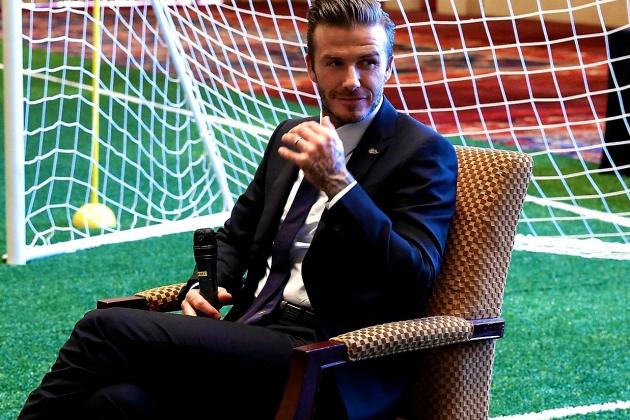
There has certainly been a lot of speculation around the question of whether David Beckham is really going to launch his own Major League Soccer team in South Beach.
Well the international superstar and his team got one step closer to that this past Friday when the City of Miami came to a verbal agreement for the soccer specific stadium to be built next to Marlins Park at the former Orange Bowl site. David Beckham’s group states “We firmly believe we can build a world-class stadium at that site.” The site has always been the favorite to land a pro soccer field after Beckham’s first two pushes to build a stadium on the waterfront fizzled.
The proposed soccer specific stadium would be adjacent to Marlins Park in Little Havana, Miami.
According to Beckham’s group, MLS officials have been visiting the area and are supportive of building a soccer-specific stadium on the site. When talks first started about the land there had been discussion about a joint football-soccer stadium where the University of Miami football team would also play. However, those talks stalled, and now Beckham’s stadium would be soccer specific. While Beckham’s group plans to privately fund the stadium, the land is largely city owned which begs the question will taxpayers get rent in the deal? Another questions remains as to what will happen to residents in the area?
The Miami Orange Bowl will be the location of the new soccer specific stadium. The Orange Bowl was the former home to the University of Miami football team who now play in Sun Life Stadium.
Miami Commissioner Francis Suarez expects the commission on Thursday, July 23rd to officially approve a negotiation between Beckham United and the city. And while there is still quite a few details to be worked out, it certainly seems as though the stadium is more likelier than not going to happen. In a letter last Friday, Beckham’s group released the following:
Three years, three years, 2017. That’s the idea if it all works out like we hope. I think three years is the objective because we’re creating a soccer team from scratch. We have to pick coaches, we have to involve the community, we have to pick a name, pick a jersey, we have to convince big-name players to come play for us.
The MLS has already awarded Miami the franchise, but had said they needed to start seeing some progress made on the stadium. 18 months had passed since Beckham first announced his public launch to his stadium quest. Cruise interests blocked his design attempts on Port Miami. The deadline for Beckham to exercise his option for an MLS franchise has been extended several times.
Pictured above is Don Garber (left), Commissioner of Major League Soccer, David Beckham, and Miami Dade County Mayor Carlos Gimenez (right) at a February 2014 media event.
So who makes up David Beckham’s ownership team? The two other big names on Beckham’s ownership team are Marcelo Claure and Simon Fuller. Marcelo is Bolivian and is the current CEO for the Sprint Corporation. In 2008, Marcelo bought BAISA, the entity that operates Bolivar, a soccer team in Bolivia. He also serves on FIFA’s Committee for Fair Play and Social Responsibility. The other partner is Simon Fuller, who is an English entrepreneur, artist manager and television producer. Simon is best known for his creation of the Idol franchise that was originated in the UK and sold to more than 100 countries including American Idol in the US. Simon and Beckham have been business partners for a while.
While there is no team name officially announced, rumors are that the “Miami Vice” or the “Miami Current” are the leading contenders. With Miami serving as the Latin American capital of the US there would certainly be a very strong fan base around the franchise. Moreover, with the face of David Beckham behind the organization, Major League Soccer certainly wants to see this franchise happen for all sorts of marketing and advertising advantages. The last obstacle is getting that final signature from the City of Miami.
On Wednesday, Nike officially announced a shoe and apparel deal with the University of Michigan that was worth $169 million. The contract begins in the 2016-17 fall season and will run for 11 years through 2027, with an option to extend through 2031. The cash and equipment part of the deal over the guaranteed 11 years is worth $122.3 million, with $65.5 million in cash and $56.8 million in apparel and equipment. There will be another $46.6 million in cash and apparel through the four-year option. The only larger school and apparel deal in the country is Notre Dame’s deal with Under Armour that was worth in the neighborhood of $90 million over 10 years.
Under Armour CEO Kevin Plank (right) announces the deal worth $90 million over the span of 10 years with University of Notre Dame with the school’s athletics director, Jack Swarbrick.
Michigan’s current deal with Adidas was worth $8.2 million a year in cash and equipment and was the most lucrative among public schools in the country. The new deal struck with Nike will be worth $11.26 million per year over the course of the next 15 years.
University of Michigan Athletic Director Jim Hackett opted to partner with Nike over Adidas despite a higher offer made from Adidas.
According to reports, Nike was in fact the lowest bidder for the Wolverines new deal. However, given the angst over the much-criticized Adidas deal, Michigan interim athletic director Jim Hackett felt making the right deal with the right partner was important:
After careful consideration, the right partner for the University of Michigan was Nike. This decision is about more than Michigan athletics; at the core, it is about our University community and it is about two great names reuniting for an opportunity that speaks to more than uniforms and apparel.
This deal dwarfs Nike’s next largest shoe and apparel deal with a public school (Florida State) by two and a half times. Nike gives the Seminoles $4.4 million a year in cash and gear.
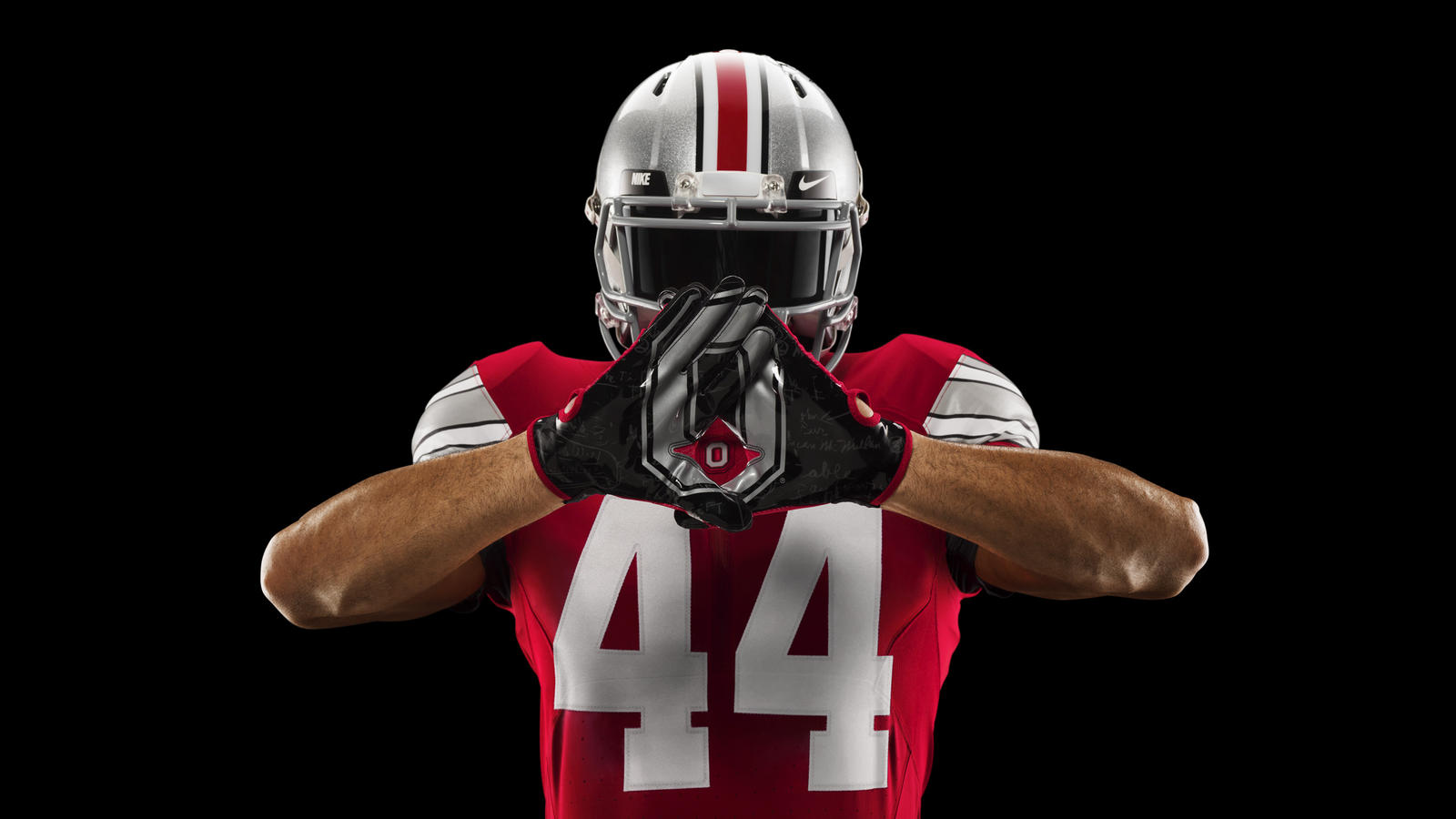
Comparatively to other Big Ten Schools, the deal doesn’t even come close to the next largest deals. Ohio State has the next largest deal that is worth about $4.16 million per year in cash and gear with Nike, followed by Wisconsin’s $3.5 million per year contract with Adidas and then Nebraska’s $3 million per year contract with Adidas.
Despite Michigan’s relatively weak performance in both basketball and football over the past few years, the shoe and apparel titan went to the mat for the Wolverines.
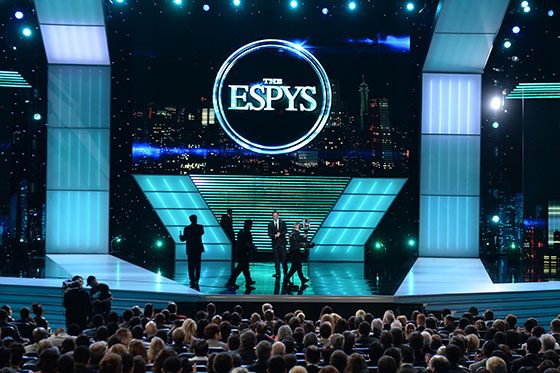
On Wednesday evening in downtown Los Angeles at L.A. Live’s Microsoft Theater, ABC and ESPN put on the 23rd annual ESPY Award Show. Actor and comedian Joel McHale hosted the award show, and spared no one in the audience, with jokes about Donald Trump deporting Triple Crown jockey Victor Espoinoza to Mexico, Super Bowl runner-up Russell Wilson choosing to throw and not run the ball on the goal line against the Patriots, and the lack of action in the Mayweather-Pacquiao fight. While McHale, like most previous ESPY hosts, set a tone of lightheartedness through comedy, the show simultaneously highlighted some stories that transcend sports to bigger issues.
Joel McHale hosted the 23rd ESPY’s and took a number of digs on the world’s top athletes in his opening monologue.
One of these heavier stories was that of Cincinnati Bengals defensive tackle Devon Still and his cancer-fighting daughter, Leah. The two were honored for the Jimmy V Perseverance Award because of how they served as a beacon of hope for other families facing similar battles. In June 2014, Leah was diagnosed with Stage IV neuroblastoma, a rare pediatric cancer that left her with a 50-50 chance of survival. Devon was unable to concentrate on football that summer and so the Bengals placed him on the practice squad, which meant Leah would still be covered by the team’s health insurance policy. Devon delivered a moving speech stating, “I always used to dream about how I was going to be able to show [Leah] so much about life, but in the five years I’ve been with [her], she has taught me more about life than I could ever do.”
Cincinnati Bengal Defensive Tackle Devon Still and his daughter Leah, who has been battling a rare form of pediatric cancer, were honored with the Jimmy V Award for Perseverance.
Another moving story was that of Lauren Hill who was honored for the Best Moment. Hill was a Division III women’s basketball player at Mount St. Joseph’s who inspired people with her fight against brain cancer. Her dream was to just play in one college basketball game. The NCAA agreed to move Mt. St. Joseph’s opening game against Hiram College up by two weeks because her condition was deteriorating. Xavier University offered it’s 10,000 arena so more people could attend the game, and sure enough tickets sold out in less than an hour. Hill inspired people with her fight against brain cancer and helped raise over $1.5 million in cancer research before she lost her battle to the disease on April 10th. Her parents, Brent and Lisa Hill, accepted the award on her behalf.
Brent & Lisa Hill, parents of Lauren Hill, accept the award for Best Moment. Lauren was a Division III women’s college basketball player who died of brain cancer but was able to play in Mount St. Joseph’s opening game and help raise $1.5 million towards cancer research.
As is tradition with the ESPY’s, the big moment of the award ceremony was the presentation of the Arthur Ashe Courage Award. The Arthur Ashe Award was awarded to Caitlyn Jenner – the transgendered woman formerly known as Bruce Jenner. Caitlyn Jenner delivered a very emotional speech where she thanked her family for unconditional support and urged acceptance for others who are transgendered. As you might imagine the award presentation was met with mixed responses and some controversy, but she received a standing ovation from the star studded audience after the 10-minute speech.
From the stage, Caitlyn Jenner thanked Diane Sawyer, who interviewed her in an interview on ABC in April and helped break the news to the world that she was becoming a woman. Noting her powerful celebrity platform, the 1976 Olympic decathlon champion and current reality TV star vowed “to do whatever I can to reshape the landscape of how transgender people are viewed and treated.” Bruce Jenner was the epitome of masculinity as the 1976 Decathlon Olympic Champion with big muscles and supreme athleticism, and so this announcement was all the more surprising. Coming on the heels of the gay marriage rights announcement, Caitlyn Jenner’s story and this award seemingly gained extra attention especially among social right activists.
Caitlyn Jenner, formerly known as Bruce, was the 1976 Olympic Decathlon World Champion and won the Arthur Ashe Award for Courage after coming out as a transgendered woman.
The award was marked with controversy when RadarOnline.com reported Wednesday that Jenner’s representatives approached ESPN suggesting the network give her the Ashe award in exchange for plugs on her upcoming E! documentary series “I am Cait.” Allegedly, Jenner’s representatives approached ESPN, prior to the ABC interview with Diane Sawyer, forming an agreement to do the interview on ABC in exchange for the Arthur Ashe Award. Disney owns both ABC and ESPN.
Whether or not these reports are accurate, some have expressed disagreement with using the ESPY’s as a platform for such issues like gender identity and transgendered equality. And while these topics are controversial in nature, it seems by the rating numbers and the audience reaction, the Arthur Ashe Award for Courage was extremely well received. The three hour show averaged a 2.2 rating/8 share in adults 18-49 and 7.7 million viewers overall on the ABC stations from 8 to 11pm. These numbers more than tripled last year’s telecast on ESPN which did a demo rating of 1.1 and only about 2.2 million viewers.
The US Women’s Soccer Team won the Best Team of the Year Award.
Other highlights of the show included the US Women’s Soccer team taking home the Best Team of the Year, Rob Gronkowski winning Best Comeback Athlete, Odell Beckham Jr’s one-handed catch taking Best Play, Steph Curry capturing Best Male Athlete and the Patriots-Seahawks Super Bowl XLIX winning the Best Game Award.
The ESPY’s once again proved to the world the unifying effect sports have on society and how sports can effectively be used as a vehicle to bring attention to widespread global issues.
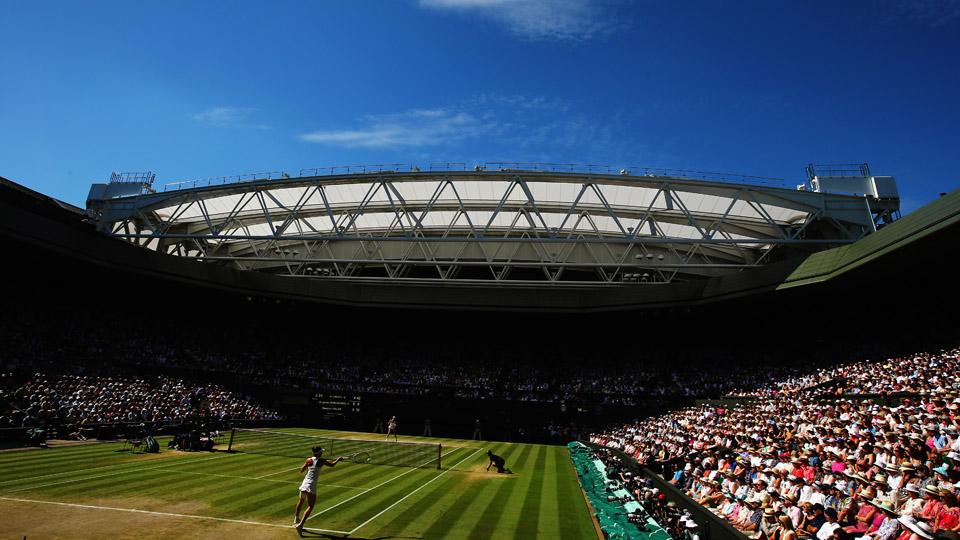
Wimbledon is considered to be the pinnacle of tennis. Why is that? One, Wimbledon is the oldest tennis tournament in the world, dating back to 1877, only a few years after the invention of the modern game. Not only that, but the game originates in Britain and is considered to be “at home” with the Wimbledon Championships. Similar to the Golf Masters in Augusta, Georgia, the All England Club has worked hard to maintain the old customs and rituals, as all players must predominantly wear white and are expected to curtsy or bow towards the royal box. And so these traditions have created a special aura around this tournament.
The Wimbledon Championships at the All-England Lawn Tennis and Croquet Club in London, England.
This weekend in London the 2015 Wimbledon Tennis Championships concluded in memorable fashion once again. On Saturday, Serena cemented her dominance on the women’s game with 21st Grand Slam Title against Garbine Muguruza 6-4, 6-4. The 33-year-old took home her 6th Wimbledon title, and her 28th consecutive victory in a Grand-Slam match. Meanwhile, the two heavyweights (Number 1 and Number 2) did battle earlier today on Centre Court, with Novak Djokovic beating Roger Federer 7-6, 6-7, 6-4, 6-3 to defend his Wimbledon Title and win his 3rd overall.
Let’s start with Serena. To the casual fan, there is nothing shocking about another Serena victory, but in looking at exactly what she has done for as long as she has done it … it’s quite remarkable. Her 16-year gap between her 1999 US Open win and Saturday’s Wimbledon championship is the largest in women’s tennis history. Her 21 Grand Slam victories rank second all time, only trailing Steffi Graf. Moreover, Serena is the current champion of each of the four Grand Slam events: the Australian Open, the French Open, Wimbledon, and the US Open. And at 33 years and nine months, she became the oldest women’s tennis player to ever win a Grand Slam title, eclipsing Martina Navratilova, who was a month younger when she won Wimbledon in 1990.
Serena Williams won the Ladies Final at Wimbledon 2015 against Garbine Muguruza.
She has seemingly become better with age as she has transcended her sport to be able to comfortably say she is the best female tennis player of all time. Comparing athlete’s dominance across different sports is an inexact science, but certainly her dominance and longevity outshines the likes of LeBron James or Tiger Woods.
The arch of a typical professional tennis career resembles that of a pop star: ascendant at 17, dominant at 21, washed up and done by 30. And yet, Serena who will turn 34 in September, is playing the best tennis of her career.
Serena lifting the US Open trophy at the age of 17 back in 1999.
On the men’s side it has been a four horse race for the last several years with the likes of Roger Federer, Rafael Nadal, Novak Djokovic and Andy Murray all sharing Grand Slam Titles. The top two coming into Wimbledon were Djokovic (#1) and Federer (#2), and sure enough both held serve through the field meeting in the final earlier today. The matched lived up to the hype as Federer went up an early break in the first set, only to see Djokovic break back and win in a tiebreaker. In the second set, the opposite happened, as Djokovic went up a break early only to see Federer claw back. Similarly, in the tiebreaker, Federer went down early but saved 6 set points to win a memorable 2nd set tiebreaker. After a brief rain delay, Djokovic cruised relatively easily to take the following two sets 6-4 and 6-3 to defend his Wimbledon title.
Novak Djokovic (left) and Roger Federer (right) lift the champion and runner-up trophies on Sunday, July 12th at the All-England Club.
Legendary tennis coach Nick Bollettieri came out this weekend saying that Djokovic is the “perfect tennis machine” referencing everything about his game to his fitness to his personality. John McEnroe said he is the greatest returner in the history of the game. Surely, his back-to-back Wimbledon titles and his current world #1 ranking signal his current dominance.
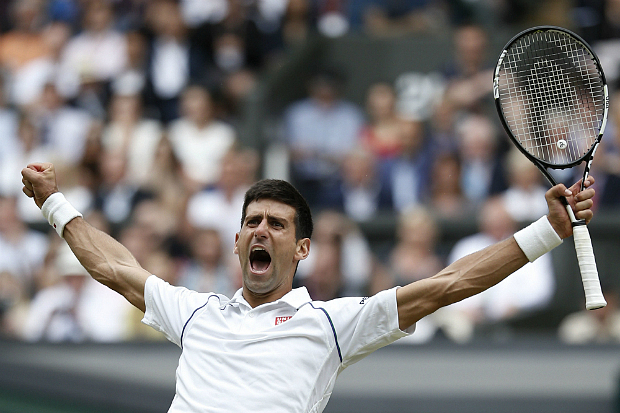
The world’s current #1 player celebrates after winning his 3rd Wimbledon title.
After this entertaining Wimbledon Championship, tennis fans have lots to look forward with the summer series of tournaments leading up to the US Open in September.
On Sunday the US Women’s National Soccer Team won it’s third FIFA World Cup emphatically over Japan by a score of 5-2. The game broke television records as it was the highest metered market rating ever for a soccer game in the United States on a single network (FOX). Sunday’s game averaged 26.7 million viewers, with 25.4 million watching the English telecast on Fox and another 1.3 million viewing the Spanish telecast airing on Telemundo. In fact, the audience was larger than that of every NBA Finals basketball game since 2010 as well as every World Series baseball game since 2004.
Morgan Brian #14, Carli Lloyd #13, and Alex Morgan #10 celebrate an early goal in the US’ victory over Japan on Sunday.
The previous soccer television viewing high in the US was 18.2 million on ESPN last year for the United States-Portugal group stage Men’s World Cup contest. While, the previous high for women’s soccer in the States was 18 million set in 1999 for the World Cup final on ESPN between the US and China. Moreover, Sunday was a 77 percent jump from the 2011 final that also featured the US and Japan on ESPN. I’m not sure anyone truly expected the numbers to be as high as they were. However, given the holiday weekend, and without any major competing sporting events, the US Women did exactly that, and they delivered.
And while the US women receive an additional $2 million for winning the World Cup (a mere fraction of the $35 million the men are awarded), the players will receive supplemental earnings in endorsements. Players like Carli Lloyd, Alex Morgan and Hope Solo will certainly capitalize on their sponsorship and endorsements deals with companies like Nike. Team apparel sales went up 3,000 percent on Sunday.
Jul 7, 2015; Los Angeles, CA, USA; United States forward Alex Morgan at 2015 Womens World Cup champions celebration at Microsoft Square at L.A. Live.
The US demographic tends to be a “big event” audience, as Americans tend to support their National teams in big international competitions. So the question remains will these shockingly high rating numbers transfer over to the National Women’s Soccer League (NWSL). All but one of the women on the US World Cup team currently play in the NWSL which gives the league great exposure.
In the last 20 years, there have been four professional women’s soccer leagues: the W-League, the WUSA, the WPS, and now the NWSL. The first three folded after no more than three seasons due to poor league management and a general lack of interest. However, it seems like the NWSL is going to be here to stay this time around due to the significant investment US Soccer has made into the league. The timing of the 1994 Men’s World Cup being hosted in the States prior to the launch of the 1996 Major League Soccer on the men’s side is very reminiscent to the timing here with the NWSL. In aligning the sports largest event around the launching of the league helps build momentum for fan interest and ticket sales.
Carli Lloyd became an international hero overnight after scoring a hat-trick in the US’ World Cup win.
There has already been a significant uptick in ticket sales, as the Houston Dash expect a record attendance of 15,000, as they only average 4,500. The Portland Thorn expect their first ever sell-out crowd of 21,000 next Wednesday. Meanwhile, the Seattle Reign host Western New York this weekend and expect to double their average attendance of 3,000 to 6,000. The question remains though, will the league be able to maintain these ticket sales through until the final week of the season in September.
Sunday proves that the United States is becoming more and more of a legitimate soccer nation. We will see if the Women’s luck on Sunday carries over to the Men’s side as they continue their Gold Cup run tonight against Haiti in Foxboro, MA. Meanwhile, the US Women will be celebrating in a parade four hours south in New York City.
While many Unite States soccer fans point towards the growth of Major League Soccer, most soccer fanatics around the world continue to view the MLS as the place where good footballers go to earn their final paycheck. And while that may be partially correct in looking at guys like David Beckham and Thierry Henry, and most recently Steven Gerrard and Frank Lampard, there is one organization that stands out above the rest within the league, the Seattle Sounders.
The Seattle Sounders’ average attendance last season was 43,734 which would have put them sixth in the English Premier League (behind Manchester United, Arsenal, Newcastle United, Manchester City and Liverpool) and the 27th most supported in the world. In fact, the Sounders double the attendance figures of the next best MLS team. And yet many soccer fans around the globe don’t realize that because the organization is relatively brand new. So how have the Seattle Sounders been so successful so quickly in putting butts in seats and filling an NFL stadium every single home game?
Let’s first look at the top. The executive team is a crossbreed between the Seahawks and the Sounders. The vast majority of the organization’s employees, from ticket sales to corporate sponsorship sales to the business development team, work for both organizations simultaneously. This co-existing business relationship is rare for MLS teams that share a stadium with an NFL team. All business decisions are made with both organizations in mind. It is not until the actual technical aspects (scouting, player development, etc) where the Seahawks and Sounders organizations divide.
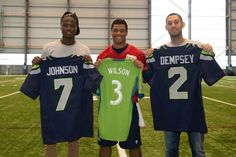
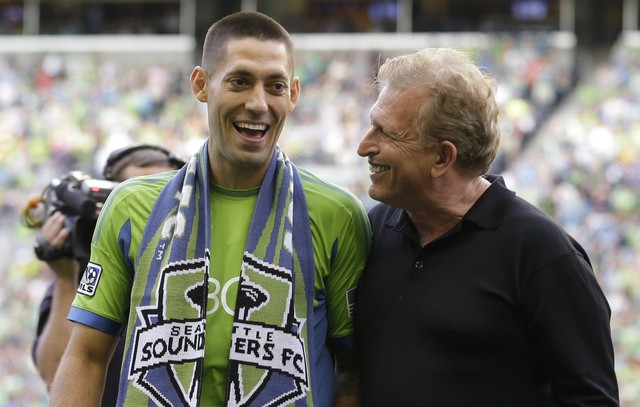
Eddie Johnson (left), formerly of the Seattle Sounders, Russell Wilson (middle) QB of the Seattle Seahawks, and Clint Dempsey (right), current captain of the Sounders all pictured together.
Secondly, the organization is run very democratically. There are 41 “alliance” season ticket members that sit on a council (voted on by all season ticket members) who meet with ownership on a quarterly basis to talk about strategy. The key, according to senior management, is keeping the fans engaged and excited because that ultimately drives everything. The decision to acquire Clint Dempsey was heavily weighed in on by the fans who wanted to see it happen. Moreover, every four years, the General Manager’s job is voted on by the fans, a practice implemented by Barcelona and Real Madrid in the Spanish Primera League.
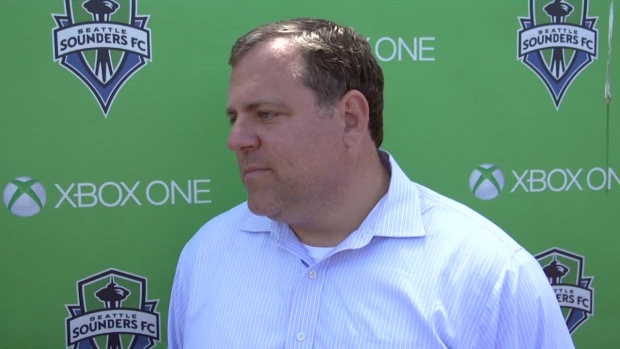
Garth Lagerway, the Seattle Sounders newest General Manager and President of Soccer.
When the franchise was bought in 2007, there were so many smart owners investing large amounts of money. Nonetheless, the Sounders seemed to pick up on some vital details involving fan engagement that helped elevate the club considerably higher than all others. For instance, the Sounders organization utilized their biggest supporter club “Emerald City” to lead a “March to the Match” an hour prior to every game to generate a true home field advantage, generally attracting three to eight thousand fans.
This group gets particularly rowdy when the Portland Timbers come into town. The Seattle-Portland “derby” is considered the best rivalry within United States soccer as it has spanned across several leagues including the USL, A-League, the NASL and now the MLS. The MLS has seemingly keened in on this notion of rivalries growing the game with the addition of New York FC this year (with the NY Red Bulls right next door) and Los Angles FC coming on in 2016 (with the LA Galaxy being right next door).
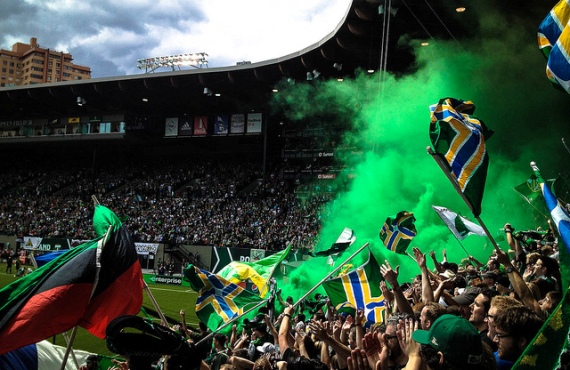
The Portland Timber’s largest supporter group, the Timber’s Army, in Providence Park during the Great Northwest Derby against the Sounders.
Joe Roth, the majority owner of the Sounders, explains his research on developing the Seattle Sounders organization from a minor league team to a major league team practically overnight, “I didn’t pay much attention to the past. I did my homework on Seattle. What I found out was that Seattle has the highest per capita youth soccer participation in the United States, an adult league that had 60,000 people, a minor league team that was drawing five to eight thousand fans while other minor league teams were drawing a thousand fans and that AC Milan came over here on two weeks notice and completely sold out the stadium.”
Clint Dempsey, left, captain of the U.S. National Soccer Team, is introduced as the newest member of the Seattle Sounders FC MLS soccer team by majority owner Joe Roth, right, Saturday, Aug. 3, 2013, prior to a match between the Sounders and FC Dallas in Seattle.
At the end of the day, the way any businessman measures a business is the bottom line; that is the profitability. The team is worth five times the value it was when they started, where now the organization is estimated to be worth roughly around $150 million. Roth points to their fan base as an advertiser’s dream with their focus demographics being 18-49 year olds, 60% male/40% female, and an average income of over $100,000. Roth says, “Soccer is generational. Twenty years from now, this will be like the Washington Redskins where the only way you can get a ticket is inherited.”
Roth is perhaps the most passionate owner in the league today. When the Sounders lost 4-0 to the Galaxy in their first year, he was so disgusted he gave every fan their money back on their tickets, costing the organization $1 million. He says “If you’re not willing to stand out here and be part of everything, than you’re missing something.” Over the years, the Sounders ticket pricing has stayed relatively stagnant, ranking 7th in the league. According to Roth, “professional soccer in this country is very price sensitive, as it has gotten to the point of something like Notre Dame football.”
While most sports businesses look at their organizations through pie charts, spreadsheets and diagrams, the Sounders are unique in that they measure their organization’s value in their stadium. They measure their success in their fans; fans that are buying food and merchandise, who are promoting the brand organically. The team set up shop in a city rich with soccer enthusiasm and they partnered with an NFL organization that already had strong connections in the sports world and then they let the brand loose … they gave it to their fans.
In today’s culture, everything is done via smart phones, iPads, laptops, and tablet devices. Specifically, the emergence of smart phone applications over the course of the last 10 years has been rampant. Information and products have become increasingly more accessible because of this and consequentially we have seen the demise of such things like newspapers, taxis, and cd’s. We’ve seen innovative new services in industries from transportation, to social media to banking with such apps like Uber, SnapChat, and Venmo.
This trend is very quickly transferring over to the sports world. There are thousands of different types of sports apps ranging from the $30 billion fantasy sports industry to sporting news delivery to video coaching applications. Content and information is as accessible as ever in today’s world. People live with their cell phones by their sides, and if they want something, there is no reason they have to reach any further than their pocket.
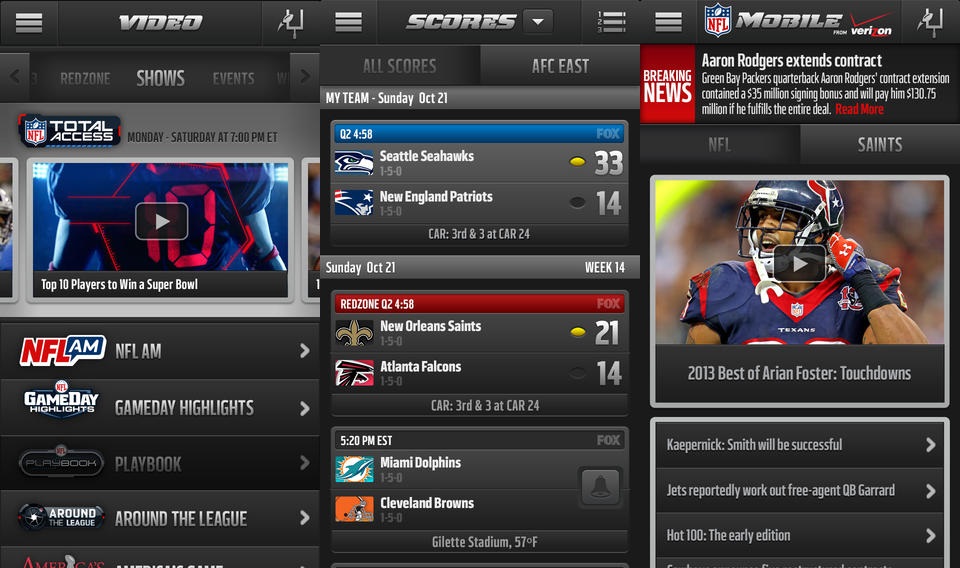
The NFL may have the best league sports app with NFL Mobile, enabling users to get live score updates, fantasy alerts, and other news. While Verizon subscribers get access to live video on the app as well.
Professional teams, leagues and even events are all adapting applications so fans can access news, follow scores, buy tickets and interact more readily. Teams have learned how to effective leverage their fans social media networks via in-games promotions and giveaways that, which in turn, exponentially increase a team’s viewership. On the amateur side, youth sport clubs are using apps to disseminate information to parents as quickly as possible. Tournament coordinators are using apps to inform teams of the latest draws and what field they need to be at and when.
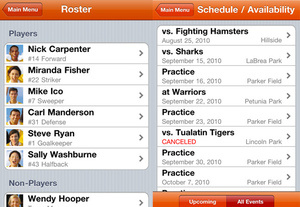
Youth and high school team administrators are using applications like TeamSnap that organizes schedules, scores, field directions, and photos for players and parents to quickly get updated news rather than relying on an email or individual phone calls.
TeamSnap enables coaches and administrators to disseminate information on a live basis to players and parents to inform them of practice, game and field changes.
SportsBoard is a relatively new application that enables sports camps to give video, audio and text feedback on a camper’s performance with corresponding grades. Moreover, it enables college coaches to organize their recruiting camp pipelines with video content, tracking systems, and systematic communication.
The WatchESPN app is the most popular sports app for Android users.
In looking at the 2015 list of top sports apps for the Android, the major sports media outlets dominate the top 10. The WatchESPN app ranked #1, as this is a must-have app if you’re a cable subscriber. The WatchESPN app allows you to login via your cable provider and access exclusive ESPN content as well as watch ESPN Live. TheScore came in ranked #2 as it is essentially an app that provides all kinds of news, analysis, stats and scores for every sport you can think of, and you can create your own feed where it brings you stories only from your favorite teams and sports. The rest of the top 10 includes ESPN, CBS Sports, NCAA, Fox Sports Go, NFL Mobile and Yahoo Sports.
The common denominator in all of these digital sports trends is the need for real time, live information. Twitter has become the fastest media outlet of live information where users can type a quick tweet as soon as they learn something, and then that is retweeted and all of a sudden news begins trending. A good example of this is the RII Sport Technology’s GameDay Scout app, where high school and college football coaches are using this mobile application to capture detailed, real time data and then are using the app to understand the tendencies of their opponent in order to make in-game adjustments.
While the demand is certainly there, the supply is quickly getting there with apps being made daily. Smart phone apps can be produced for as low as $10,000 or as much as $2 million depending on the sophistication and interface design quality. While the major revenue streams for apps come from advertising and corporate sponsors, partnership incentives are quickly adding additional revenue dollars for app designers. In 2015, more and more sports businesses are learning how to capitalize on this ever-growing market.
One “arena” of the sports business world that is often overlooked is the athletic training facility for professional athletes, specifically for the sports of football and basketball. Many of the high profile collegiate or amateur athletes who declare themselves eligible for the NFL or NBA drafts chose to do their training at a world-class sports training facility. With the NFL draft less than 2 months past, and the NBA draft only 5 days away, this seems to be a highly relevant topic.
I think it might be important to understand the dynamics of this business before diving into the details of it. While these training facilities exist for athletes across all sports, the training facilities that focus on athletes preparing for the NFL and NBA drafts are easily the biggest. That is because those two drafts are the biggest in magnitude. The MLB draft has 40 rounds and thus loses its luster. Moreover, many of those prospects spend several seasons in the minors or play college ball before seeing a major league roster. Similarly, the NHL draft does not give fans the immediate satisfaction of seeing players that are “NHL ready.” It takes most top picks in the NHL draft 3-4 years before they are actually playing in an NHL game. Conversely, the NFL and NBA drafts generate lots of buzz, interest, and excitement from fans because nearly all first round picks are just about guaranteed to make their teams the following year giving fans a reason to watch the event on TV.
The NHL Draft attracts very low attendance figures compared to the NFL and NBA Drafts.
Many of the top agencies will sign athletes right when they declare themselves eligible for the NFL and NBA drafts. Both the NFL and NBA have formal pre-draft combines that are essentially showcases for NFL and NBA management to examine players. They both happen 1-2 months before the draft and allow NFL and NBA GM’s, coaches, and scouts to see all of the athletes’ performance measurements (bench press, vertical jump, etc). Because so much weight is put into these athletic measurements, agents will pay top-dollar for their signed athletes to do their pre-draft training at the very best facilities in the world. With GM’s making million dollar-drafting decisions sometimes based upon a tenth of a second in a wide receiver’s 40-yard sprint, the return on investment for agents on sending their clients to the very best facilities is ever important.
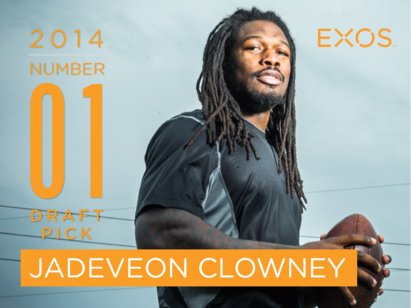
This opens up a market space for facilities that specialize in training professional athletes. To begin with, it’s a very saturated marketplace with hundreds and hundreds of trainers and facilities doing various versions of the same thing. One of the biggest training facilities is EXOS, formerly known as Athletes Performance. EXOS was founded in 1999 by Mark Verstegen and has exponentially grown to where now they have facilities in Tempe (AZ), Phoenix (AZ), Carson (CA), San Diego (CA), Gulf Breeze (FL), Raleigh (NC), and Frisco (TX). They boast 523 players drafted, seven #1 overall picks and 105 first-rounders. Jadeveon Clowney, Greg Robinson and Blake Bortles all attended EXOS and obviously their hard work at these facilities paid off with big pay-days as the #1 overall pick in the NFL drafts.
Another top facility for NFL pre-draft combine training is IMG Academy in Bradenton, FL. The Academy started as a tennis academy with the one of the best tennis coaches of all time, Nick Bollettieri, who was responsible for training about half of the draw in the 1986 US Open. From there, the deep pockets of IMG (International Management Group) were able to take it from purely a tennis academy to a world class training facility for many more sports, football and basketball being two of them. Within the last 10 years or so, IMG has landed 86 first round picks, five #1 overall picks, including names like Cam Newton, LaDainian Tomlinson, Luke Joeckel, Luke Kuechly, Ryan Tannehill as well as Super Bowl MVP’s like Drew Brees and Eli Manning.
The #1 overall pick in the 2014 NFL Draft, Jadeveon Clowney, trained at EXOS with Mark Verstegen.
On the basketball side, there are a few workout facilities that stand out: Impact Basketball (Las Vegas, NV), Project Basketball (Oakland, CA), and Evolution Athletics (Chicago, IL). Impact Basketball began in 1997 when former Division 1 coach, Joe Abunassar, applied his unique approach to basketball development to guide the careers of several of the best NBA players. Today, Impact Basketball has three locations as well as programs running in over a dozen countries … they have laid claim to over 100 NBA draft picks in the last 7 years. Joe’s early group of clients was Kevin Garnett, Chauncey Billups, Tyronn Lue, Al Harrington, Tayshaun Prince and Dahntay Jones. From there, Joe was able to start the IMG Basketball Academy in Bradenton, Florida. He then added facilities in Las Vegas and Los Angeles that train over 200 professionals, men’s and women’s national teams, McDonalds and NCAA All-Americans, foreign professionals and young talented amateurs who train at his summer camps and his Impact Academy.
Joe Abunassar has done an incredible job growing his Impact Basketball Academy.
Jeff Pagliocca, with Evolution Athletics in Illinois, is a little newer to the game of combine training, although is quickly building an impressive list of alumni. Everyone from Luol Deng, to Will Bynum to most recently Frank Kaminsky as well as Aaron and Andrew Harrison have used Pagliocca and his staff to prepare for the NBA draft combine.
Virtually all of these training facilities feature cross-training components including mental conditioning, speed training, nutrition, and other components of how to be the consummate professional. In virtually all of these examples of world-class training facilities, the business model has started from a well-known coach or trainer being able to attract a few big name athletes. From there it becomes a snow-ball effect in large sense, where other young up-and-coming athletes want to train where the other best athletes are training. It is here where managing the relationships with the large agencies becomes crucial, as they are ultimately the ones spending the dollars. At this point it becomes a marketing exercise, where the coaches rely on a marketing and business development staff to generate the buzz of who is coming to train at their facility and to permeate that news to the youth athletes, the high school athletes, the college athletes and even the professional athletes.
IMG Academy does a tremendous job in leveraging their NFL Draft combine athletes to market some of their other training products.
The business is now off and running and new revenue streams open up for these facilities. With the ability to market these big names, the facilities generally then create youth summer camps, individualized private training sessions, team training, events, consulting and sometimes will even look to get into player representation and player endorsements. If executed properly, the pre-draft combine training niche marketplace can have a rippling effect over a potential very large business.
It is a very saturated market with lots of facilities trying to do similar things … and like anything else; the cream generally rises to the top.
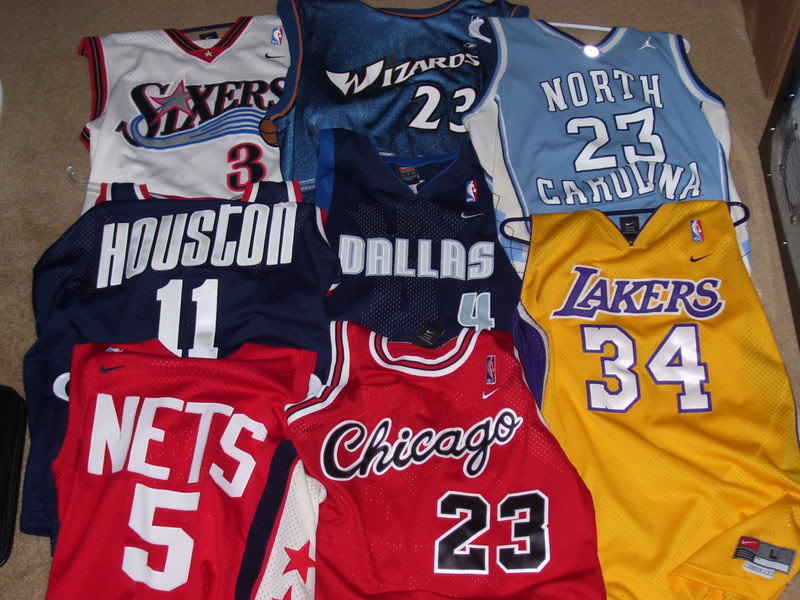
It was just announced on Wednesday that Nike and the NBA have agreed to an 8 year, $1 billion jersey deal that will begin in the 2017-18 season.
This deal will represent approximately a 245 percent annual increase from the previous deal that the NBA had held with Adidas. In 2006, the NBA announced an 11-year, $400 million deal with Adidas, who at the time had taken over for Reebok (a brand which it now owns). It was reported that Adam Silver and the NBA had become unhappy with Adidas after they fell to third in the United States in shoe and apparel sales, behind Nike and Under Armour. This past March, Adidas announced that they would not seek to extend its jersey deal with the league.
Nike has produced replica NBA jerseys through their Swingman brand line and produced official NBA jerseys in the 1990s.
You might wonder why the NBA announced this so early in advance, as their current deal with Adidas is good through the 2016-17 season. The simple answer is that both sides have already mutually agreed to part ways at the end of the deal. Adidas still wants a return on their investment, so don’t expect to see any letdown from them in the coming years. They have done some new things, such as jerseys with sleeves and their special Christmas Day branded jerseys. With Adidas and the NBA coming to this decision to split early, there was no reason for the NBA to not go ahead and search for their next official jersey supplier.
Mark Parker, the CEO of Nike, is extremely excited about the new jersey deal with the NBA.
A major win in this jersey deal for Nike is that the Nike Swoosh will appear on all NBA jerseys, a first for the league. Nike President and CEO, Mark Parker, is extremely excited about the deal, “In Nike, Jordan and Converse, we have three of the most connected brands in the world, and look forward to making the global growth of the game a successful strategy for both the NBA and Nike.” Since 1992, Nike has been a marketing partner of the NBA. At retail, they have been able to successfully produce replica NBA jerseys under their Swingman line. Furthermore, Nike and its affiliated brands, control more than 90% of the U.S. basketball shoe market at retail. The company holds endorsement deals with many of the league’s top stars: Lebron James, Kevin Duran, Kobe Bryant, Kyrie Irving and Russell Westbrook to name just a few.
Lebron James is one of several big stars that Nike has large brand endorsement deals with.
In 2012, Nike was able to win the bidding war for the official uniform deal of the NFL, and they have extended those rights until the end of the 2019 season. Most industry experts would agree that Nike has been relatively conservative with their NFL jersey designs, excluding a few franchises like the Jaguars, Buccaneers and the Seahawks. NFL owners tend to be more conservative businessman compared to those owners of NBA franchises. It is expected that Nike may have a little more creative freedom with these NBA jerseys. Having said that, with the limitation of space on the NBA jersey canvas (no sleeves, shorts and not pants, no high socks, required number on the front of the jersey), Nike’s design team will have to be resourceful to create a groundbreaking design.
One issue of debate with the new Nike NBA jerseys is whether or not there will be advertising on the jerseys. That question may largely be tied to the television deal with Turner Sports. ESPN Sports Business Reporter, Darren Rovell, says, “With such a large and lucrative ESPN/Turner deal getting done, it brought into question the worry that there might be some companies who might try to cannibalize the business of TV and not buy television advertisements. I think that’s enough of a concern to keep advertisements off jerseys until the end of the TV deal and maybe forever.”
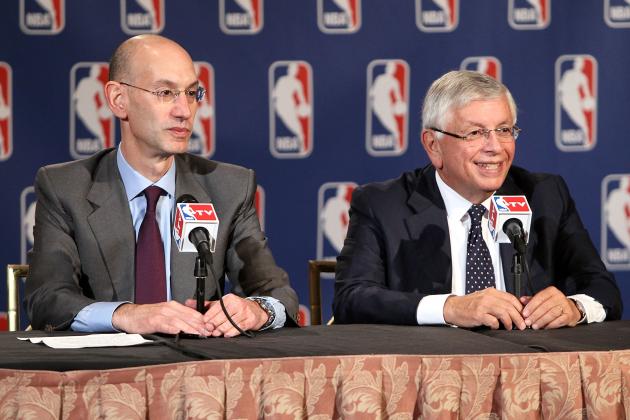
Adam Silver (left), the NBA’s current commissioner, and David Stern (right), the NBA’s former commissioner, have two different views on the league’s jerseys.
Now, Adam Silver shares a much different opinion on the NBA’s jerseys than former commissioner David Stern maintained. Stern felt strongly that there should be no other competing brands on the NBA jerseys besides the team brands, which is what negated Adidas putting their trademark logo on the jerseys. Silver, however, not only feels strongly about putting the supplier’s brand on the jerseys, but is also pushing for corporate advertising on the jerseys.
This new deal will have no impact on a few teams who have new uniform designs coming out. The Philadelphia 76ers will be unveiling new uniforms next week; while the Toronto Raptors and Atlanta Hawks will be announcing new uniform designs later this summer as well.
Regardless, this is a huge win for Nike. Nike will now have the official jersey deals for the two US professional sports leagues with the widest global marketing reach.















 Ben_Slingerland